St. Bartholomew the Apostle
Tradition
Eusebius of Caesarea's Ecclesiastical History (5:10) states that after the Ascension, Bartholomew went on a missionary tour to India, where he left behind a copy of the Gospel of Matthew. Tradition narrates that he served as a missionary in Mesopotamia and Parthia, as well as Lycaonia and Ethiopia in other accounts. Popular traditions say that Bartholomew preached the Gospel in India and then went to Greater Armenia.
Mission to India
Two ancient testimonies exist about the mission of Saint Bartholomew in India. These are by Eusebius of Caesarea (early 4th century) and by Saint Jerome (late 4th century). Both of these refer to this tradition while speaking of the reported visit of Saint Pantaenus to India in the 2nd century.
The studies of Fr A.C. Perumalil SJ and Moraes hold that the Bombay region on the Konkan coast, a region which may also have been known as the ancient city Kalyan, was the field of Saint Bartholomew's missionary activities. Previously, the consensus among scholars was at least skeptical about an apostolate of Saint Bartholomew in India.
Stallings (1703), Neander (1853), Hunter (1886), Rae (1892), and Zaleski (1915) supported it, while scholars such as Sollerius (1669), Carpentier (1822), Harnack (1903), Medlycott (1905), Mingana (1926), Thurston (1933), Attwater (1935), etc., do not. The main argument is that the India that Eusebius and Jerome refer to should be identified as Ethiopia or Arabia Felix.
In Armenia
Along with his fellow apostle Jude "Thaddeus", Bartholomew is reputed to have brought Christianity to Armenia in the 1st century; as a result, in 301 the Armenian kingdom became the first state in history to embrace Christianity officially. Thus, both saints are considered the patron saints of the Armenian Apostolic Church. According to these traditions, Bartholomew is the second Catholicos-Patriarch of the Armenian Apostolic Church.
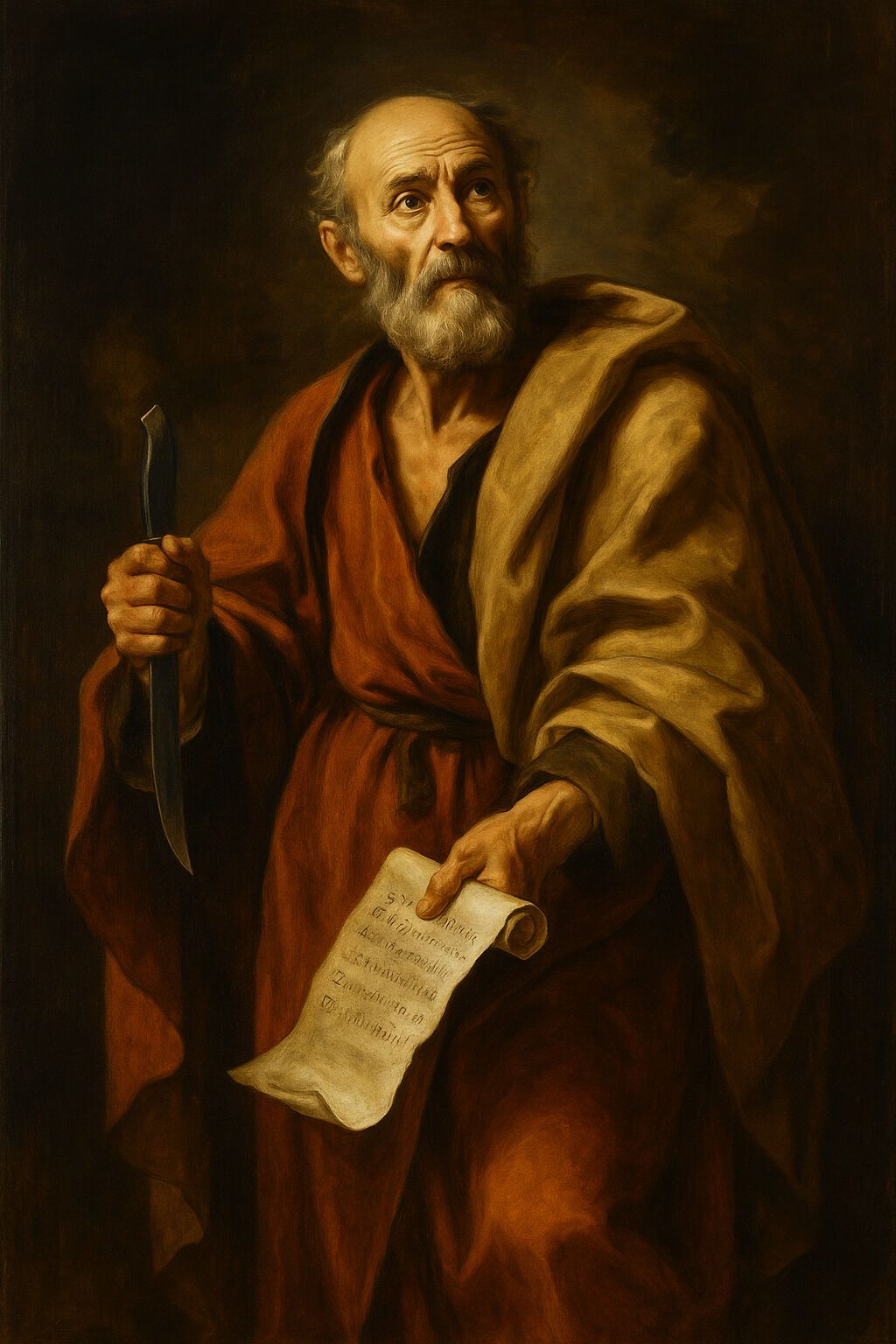
Christian tradition offers three accounts of Bartholomew's death: "One speaks of his being kidnapped, beaten unconscious, and cast into the sea to drown."
In the Hellenic tradition, Bartholomew was executed in Albanopolis in Armenia, where he was martyred for having converted Polymius, the local king, to Christianity. Enraged by the monarch's conversion, and fearing a Roman backlash, King Polymius's brother, Prince Astyages, ordered Bartholomew's torture and execution. However, this version of the story appears ahistorical, as there are no records of any Armenian king of the Arsacid dynasty of Armenia with the name "Polymius". Other accounts of his martyrdom name the king as either Agrippa (identified with Tigranes VI), or Sanatruk, king of Armenia.
The 13th-century Saint Bartholomew Monastery was a prominent Armenian monastery constructed at the presumed site of Bartholomew's martyrdom in Vaspurakan, Greater Armenia (now in southeastern Turkey).
In present-day Azerbaijan
Azerbaijani Christians hold the position that Apostle Bartholomew was the first person to bring Christianity to the lands of modern Azerbaijan and believe that he preached there. Saint Bartholomew Church (Baku) was built in 1892 with donations from the local Christian population on the site where the Apostle Bartholomew was believed to have been martyred.
Azerbaijani Christians believe that in the area near the Maiden Tower, the apostle Bartholomew was crucified and killed by pagans around 71 AD. The church continued to operate until 1936, when it was demolished as a part of the Soviet campaign against religion.
Veneration
The Armenian Apostolic Church honours Saint Bartholomew and Saint Thaddeus as its patron saints.
The Eastern Orthodox Church venerates Bartholomew on June 11. Bartholomew is also venerated on August 25 in commemoration of the transfer of Bartholomew's relics. He is also venerated as one of the twelve apostles on June 30.
In the Synaxarium of the Coptic Orthodox Church of Alexandria, Bartholomew's martyrdom is commemorated on the first day of the Coptic calendar (i.e., the first day of the month of Thout), which currently falls on 11 September (corresponding to 29 August in the Julian calendar).
Hence, the Russian Orthodox Eparchy of Baku and Azerbaijan and Catholic Prefecture of Azerbaijan honour Saint Bartholomew as the Patron Saint of Azerbaijan and regard him as the bringer of Christianity to the region of Caucasian Albania, modern-day Azerbaijan. The feast day of the Apostle is solemnly celebrated there on 24 August by the Christian laity and the Church officials alike.
In the current Roman General Calendar, Saint Bartholomew's feast occurs on 24 August.
Bartholomew the Apostle is remembered in the Church of England and all other Anglican churches with a Festival on 24 August.
Relics
The 6th-century writer Theodorus Lector averred that in about 507, the Byzantine emperor Anastasius I Dicorus gave the body of Bartholomew to the city of Daras, in Mesopotamia, which he had recently refounded. The existence of relics at Lipari, a small island off the coast of Sicily, in the part of Italy controlled from Constantinople, was explained by Gregory of Tours by his body having miraculously washed up there.
A large piece of his skin and many bones that were kept in the Cathedral of St. Bartholomew in Lipari, were translated to Benevento in 838, where they are still kept in the Basilica San Bartolomeo. A portion of the relics was given in 983 by Otto II, Holy Roman Emperor, to Rome, where it is conserved at San Bartolomeo all'Isola, which was founded on the site of the temple of Asclepius, in pagan times an important Roman medical centre. This association with medicine caused Bartholomew's name to become associated in course of time with hospitals.
A part of Bartholomew's alleged skull was transferred to the Frankfurt Cathedral, while an arm was venerated in Canterbury Cathedral. In 2003, Patriarch Bartholomew I of Constantinople brought some of the remains of St. Bartholomew to Baku as a gift to Azerbaijani Christians, and these remains are now kept in the Holy Myrrhbearers Cathedral.
Saint Bartholomew has been credited with several miracles.
Culture
The festival in August has been a traditional occasion for markets and fairs, such as the Bartholomew Fair which was held in Smithfield, London, from the Middle Ages, and which served as the scene for Ben Jonson's 1614 homonymous comedy.
St Bartholomew's Street Fair is held in Crewkerne, Somerset, annually at the start of September. The fair dates back to Saxon times and the major traders' market was recorded in the Domesday Book. St Bartholomew's Street Fair, Crewkerne is reputed to have been granted its charter in the time of Henry III (1207–1272). The earliest surviving court record was made in 1280, which can be found in the British Library.
Timeline
1st Century AD
Bartholomew is chosen as one of the twelve apostles of Jesus.
Mission to India
According to tradition, he travels to India to spread the Gospel.
Mission in Armenia
Brings Christianity to Armenia alongside Jude Thaddeus.
Martyrdom
Flayed alive and beheaded; relics distributed across Europe.
Feast Day
Celebrated on August 24 by the Roman Catholic and Anglican Churches.