Eucharistic Miracles

Faith, Mystery, and Divine Manifestations

Eucharistic Miracles

Eucharistic Miracles

Eucharistic Miracles

Eucharistic miracle is any miracle involving the **Eucharist**, regarding which the most prominent Christian denominations, especially the **Catholic Church**, teach that Christ is truly present in the Eucharist, which is by itself a Eucharistic miracle; however, this is to be distinguished from other manifestations of God. Eucharistic miracles are most known and emphasized within the context of the Catholic Church, which distinguishes between divine revelation, such as the Eucharist, and private revelation, such as Eucharistic miracles.

In general, reported Eucharistic miracles usually consist of unexplainable phenomena such as consecrated Hosts visibly transforming into **myocardium** tissue, being preserved for extremely long stretches of time, surviving being thrown into fire, bleeding, or even sustaining people for decades. In the Catholic Church, a special task-force or commission scientifically investigates supposed Eucharistic miracles before deciding whether they are "worthy of belief," in order to differentiate real Eucharistic miracles from cases of contamination by bacteria, such as *Neurospora crassa* or *Serratia marcescens*.

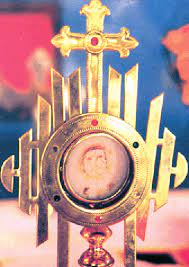
Eucharistic Miracle Image

Real Presence

**Main article:** Real Presence of Christ in the Eucharist

Roman Catholic Eucharistic doctrine draws upon a quasi-Aristotelian understanding of reality, in which the core substance or essential reality of a given thing is bound to, but not equivalent with, its sensible realities or accidents. In the celebration of the Eucharist, by means of the consecratory Eucharistic Prayer, the actual substance of the bread and wine are changed into the body and blood of Christ. This change in substance is not, however, the outward appearances of the bread and wine—their accidents—which remain as before. This substantial change is called **transubstantiation**, a term reserved to describe the change itself. Scholastic philosophical terminology was used but is not a part of the dogma that defined Christ's presence for the Roman Catholic Church at the Council of Trent.

In the 13th session of 11 October 1551, it promulgated the following conciliar decree:
"if anyone says that the substance of bread and wine remains in the Holy Sacrament of the Eucharist together with the Body and Blood of our Lord Jesus Christ and denies that wonderful and extraordinary change of the whole substance of the wine into His blood, while only the species of bread and wine remain, a change which the Catholic Church has most fittingly called transubstantiation, let him be anathema." (Session 13, can.2).

Protestant views on the fact of Christ's presence in the Eucharist vary significantly from one denomination to another: while many, such as Lutherans, Anglicans, Methodists and the Reformed agree with Roman Catholics that Christ is really present in the Eucharist, they do not accept the definition of transubstantiation to describe it. According to Thomas Aquinas, in the case of extraordinary Eucharistic Miracles in which the appearance of the accidents are altered, this further alteration is not considered to be transubstantiation, but is a subsequent miracle that takes place for the building up of faith. Nor does the extraordinary manifestation alter or heighten the presence of Christ in the Eucharist, as the miracle does not manifest the physical presence of Christ:

"in apparitions of this sort ... the proper species [actual flesh and blood] of Christ is not seen, but a species formed miraculously either in the eyes of the viewers, or in the sacramental dimensions themselves."

Some denominations, especially Lutherans, have similar beliefs regarding the Eucharist and the Real Presence, though they reject the Roman Catholic concept of transubstantiation, preferring instead, the doctrine of the sacramental union, in which:
"the body and blood of Christ are so truly united to the bread and wine of the Holy Communion that the two may be identified. They are at the same time body and blood, bread and wine. ...In this sacrament the Lutheran Christian receives the very body and blood of Christ precisely for the strengthening of the union of faith."

Lutherans hold that the miracle of the Eucharist is effected during the Words of Institution. Both the Eastern Orthodox Churches and the Oriental Orthodox Churches, such as the Coptic Church, insist "on the reality of the change from bread and wine into the body and the blood of Christ at the consecration of the elements," although they have "never attempted to explain the manner of the change," thus rejecting philosophical terms to describe it. The Methodist Church similarly holds that Christ is truly present in the Eucharist "through the elements of bread and wine," but maintains that how He is present is a Holy Mystery. All Anglicans affirm the real presence of Christ in the Eucharist, though Evangelical Anglicans (as with other Reformed Christians) believe that this is a pneumatic presence, while those of an Anglo-Catholic churchmanship believe this is a corporeal presence, but at the same time questioning the philosophical explanation of transubstantiation.

Extraordinary Eucharistic Miracles

**Mystical Fasting**
Some Catholic saints reportedly survived for years on nothing but the Eucharist. **Marthe Robin** (Venerable) fasted from all food and drink except the Eucharist from 1930 to her death in 1981. Brazilian **Servant of God Floripes Dornellas de Jesus** reportedly lived for 60 years feeding with Eucharist only. **Teresa Neumann**, the famed Catholic Stigmatic from Bavaria subsisted on no solid food but the Holy Eucharist from 1926 until her death in 1962 some 36 years later.

**Supernatural Communion**
Some saints reportedly received Holy Communion from angels. One example is the visionaries of **Our Lady of Fatima** receiving the Eucharist from an angel. Another example is **Saint Faustina** receiving the Eucharist from a seraph.

**Flesh, Blood and Levitation**
The rarest reported types of Eucharistic miracle is where the Eucharist becomes human **flesh** as in the miracle of **Lanciano**, or human **blood** as in the miracle of **Santarém**. Other miracles include consecrated hosts being preserved for hundreds of years, passing through fire unscathed, or levitating.

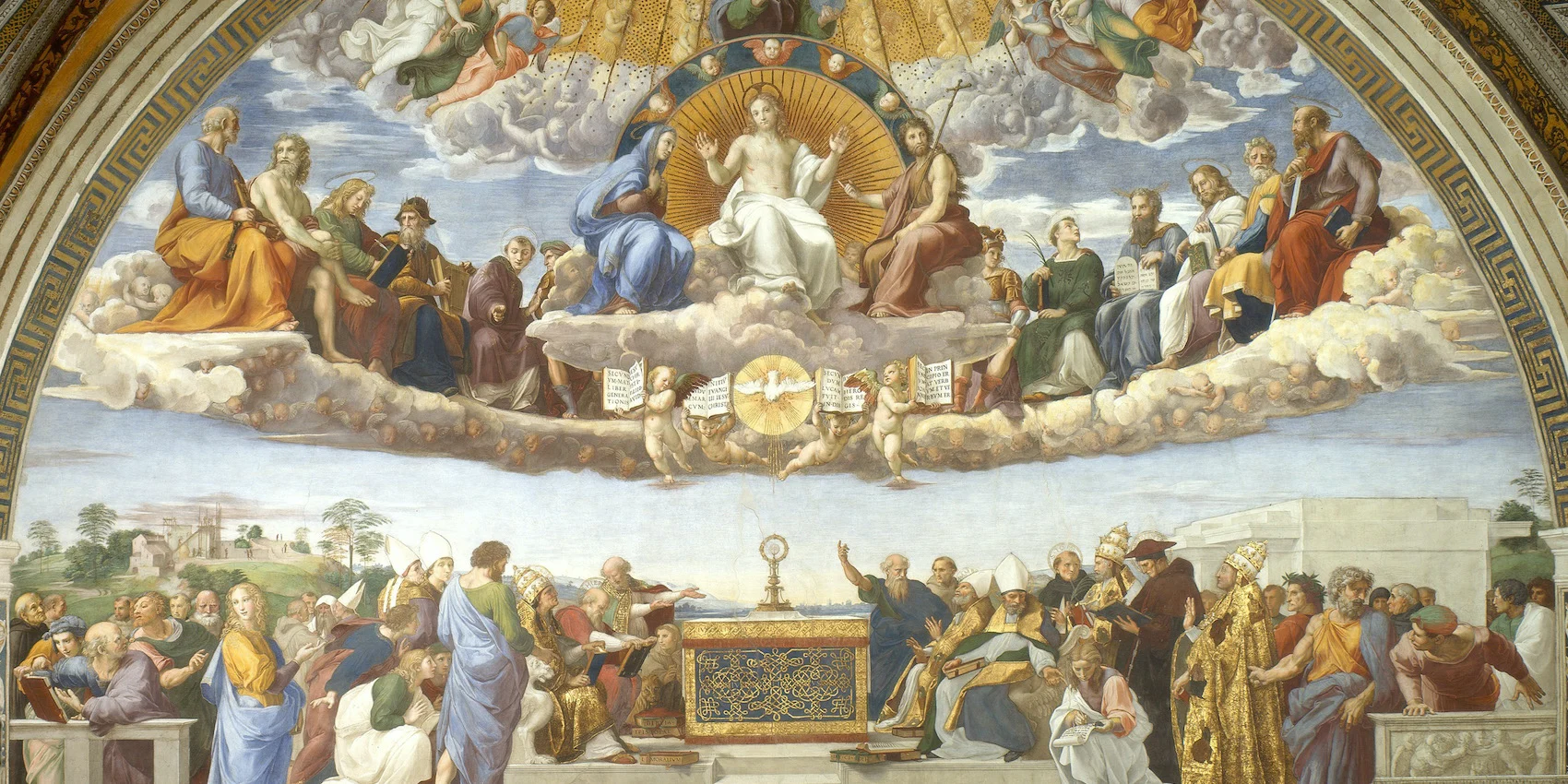
The **Mass at Bolsena**, depicted in a famous fresco by Raphael at the Vatican in Rome, was said to have taken place in 1263. A Bohemian priest who doubted transubstantiation celebrated Mass at Bolsena. During the Mass the bread of the eucharist began to bleed. The blood fell onto the altar linen in the shape of the face of Jesus. In 1264, Pope Urban IV instituted the **Feast of Corpus Christi**.

There have been numerous other alleged miracles involving consecrated Hosts, including events in **Amsterdam** (1345), **Bavaria, Brussels** (1370), and **Sokółka** (2008). Investigations into these miracles have included scientific analysis, some of which revealed natural causes, while others remain classified as genuine Eucharistic miracles by the Catholic Church.

Appearance of Image of Jesus

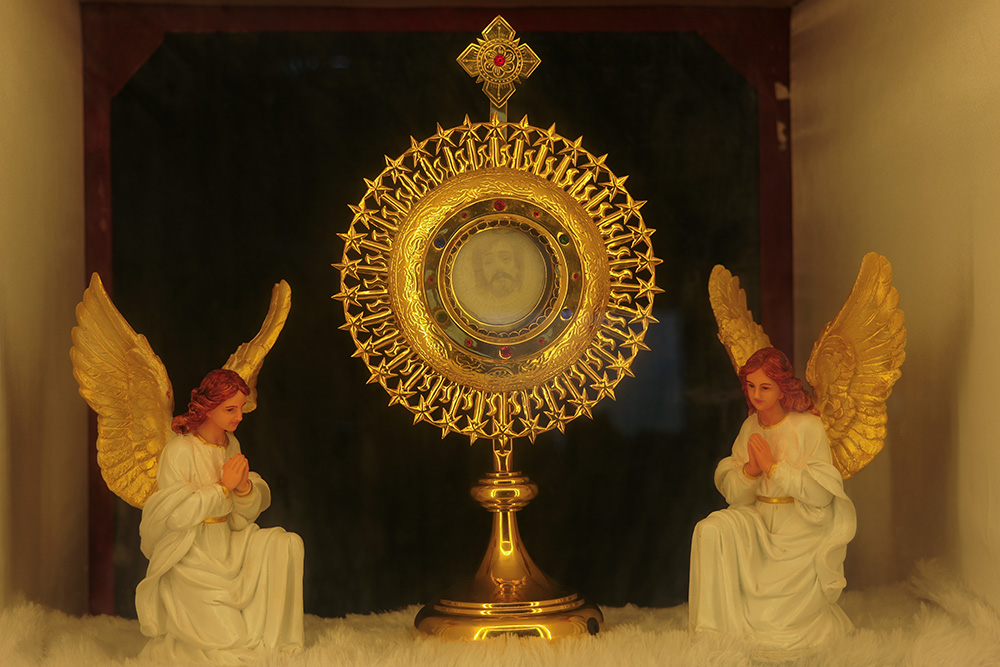
Two Eucharistic miracles were reported in the 21st century in **Kerala, India**, both of which astonished the faithful because an image resembling the face of Jesus appeared on consecrated Hosts during Mass.

The first occurrence was in 2001 at **Chirattakonam** in Kollam district. During the celebration of the Holy Qurbana, the parish priest noticed a luminous face appearing on the sacred Host during adoration. Over time, the image became clearer, and many parishioners testified to having seen it with their own eyes. This miraculous manifestation deepened the devotion of the local Catholic community and attracted pilgrims from different regions.

The second miracle was reported in 2006 at **Vilakkannur** in Naduvil, Kannur district. Once again, during the Mass, the faithful witnessed a human face — resembling Christ — appearing on the Host. What made this extraordinary was its timing, as the parish was preparing for a jubilee celebration, which the people interpreted as God’s special blessing upon their community. In both cases, photographs were taken, and devotional veneration grew rapidly.

These miracles remind believers that the Eucharist itself is the greatest miracle — Christ truly present in the form of bread and wine. Yet, such extraordinary manifestations, like those at Chirattakonam and Vilakkannur, serve as visible signs calling the faithful to deeper reverence, stronger faith, and greater love for the Holy Eucharist.

Trivandrum Eucharistic Miracle

Trivandrum Eucharistic Miracle

Reported in Chirattakonam, Kollam district, where an image of Jesus appeared on a consecrated Host.

Vilakkannur Eucharistic Miracle

Vilakkannur Eucharistic Miracle

Reported in Naduvil, Kannur district, where the Host revealed an image resembling Jesus.

Saint Carlo Acutis List

**Carlo Acutis** was an Italian Catholic youth and website designer, who is best known for documenting Eucharistic miracles around the world and cataloguing them onto a website which he created before his death from leukemia. The following list shows some of these miracles:

View Complete List